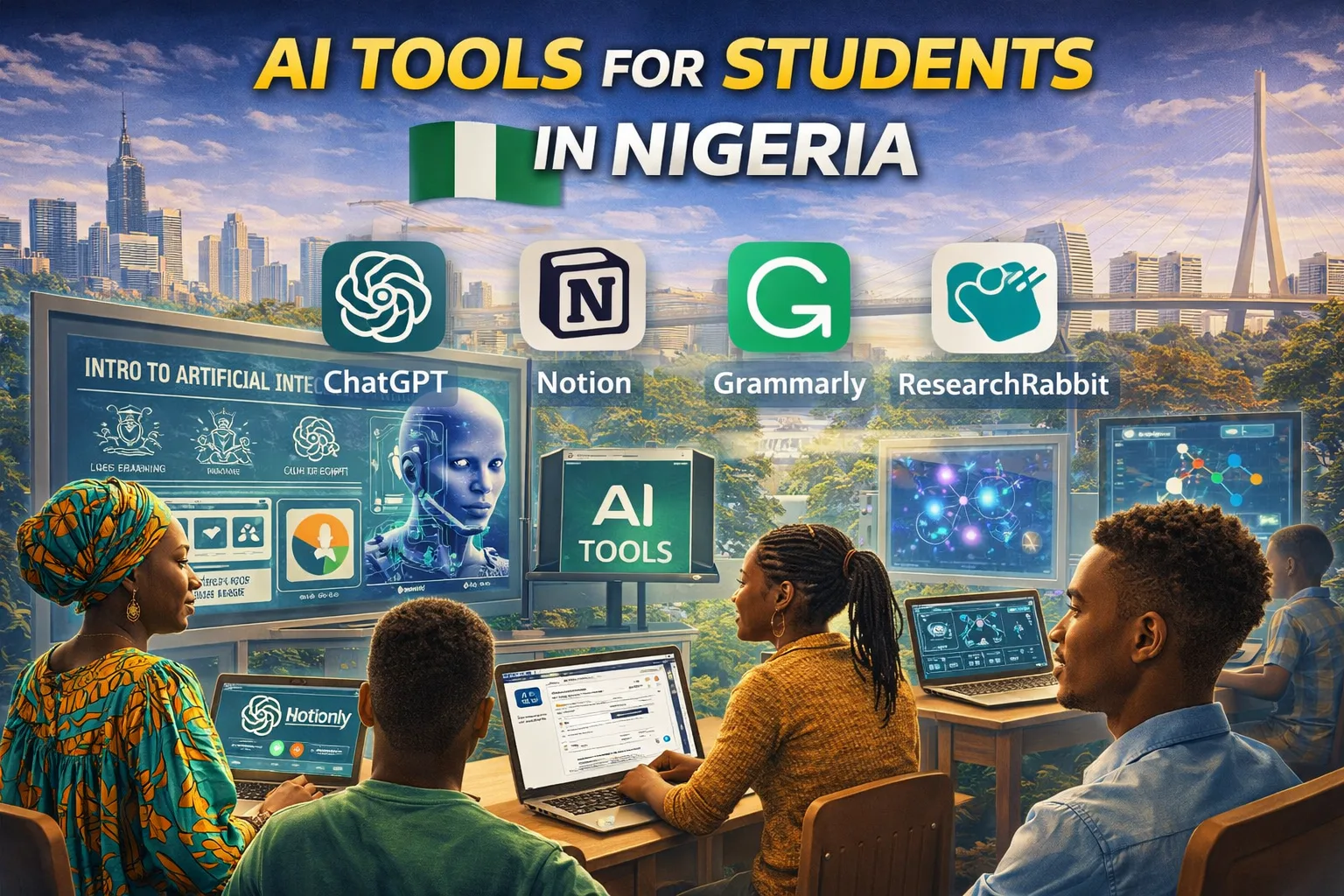
Unlocking Your Nigerian Potential: The Smart Student’s Guide to AI Tools
Nigeria, a land brimming with ambition and a rapidly growing youth population, is at the precipice of a technological revolution. As the world increasingly embraces Artificial Intelligence (AI), its potential to transform education and empower students is undeniable. For Nigerian students, navigating the complexities of learning, research, and future career prospects can be challenging. However, a new wave of AI-powered tools is emerging, offering a lifeline of support, efficiency, and innovative learning experiences.
This comprehensive guide delves deep into the world of AI tools specifically relevant to Nigerian students. We’ll explore how these technologies can alleviate common academic hurdles, enhance research capabilities, boost creativity, improve language skills, and even prepare you for the burgeoning AI-driven job market. We’ll focus on practical applications, relatable scenarios within the Nigerian context, and how you can leverage these tools to excel in your studies and beyond.
The Nigerian Educational Landscape and the AI Imperative
Nigeria’s educational system, like many across the globe, faces unique challenges. These can range from limited access to resources, overcrowded classrooms, and sometimes outdated teaching methodologies, to the ever-present pressure to perform well in exams and secure desirable career paths. The sheer volume of information available today can be overwhelming, and for students juggling multiple courses, assignments, and personal commitments, finding effective learning strategies is paramount.
This is where AI steps in, not as a replacement for teachers or traditional learning, but as a powerful augmentation. Think of AI as your personal academic assistant, a hyper-efficient researcher, a creative muse, and a language coach, all rolled into one. The Nigerian government and educational institutions are increasingly recognizing the importance of digital literacy and integrating technology into learning. As a student, staying ahead of this curve by actively exploring and utilizing AI tools is not just beneficial; it’s becoming a necessity for academic and professional success. The African Development Bank, for instance, has been advocating for the adoption of digital technologies in education across the continent, highlighting the potential for AI to bridge learning gaps and foster innovation.
AI as Your Academic Ally: Tackling Common Student Challenges
Let’s break down how AI tools can directly address the everyday struggles Nigerian students encounter:
1. Mastering the Art of Research: From Library Stacks to Digital Archives
Research is the bedrock of academic achievement. However, sifting through countless articles, journals, and textbooks can be a daunting task. Traditional library visits can be time-consuming, and even online searches can yield overwhelming results.
How AI Tools Help:
- Efficient Information Retrieval: AI-powered search engines and research assistants can understand complex queries and deliver highly relevant results. Instead of just keyword matching, they can grasp the semantic meaning of your request, saving you precious time.
- Synthesizing Information: AI can help summarize lengthy research papers, extract key arguments, and identify recurring themes. This allows you to quickly grasp the essence of a topic before diving deeper.
- Citation Management: Many AI tools can assist in generating citations in various formats (APA, MLA, Chicago), reducing the risk of plagiarism and ensuring academic integrity.
Relatable Nigerian Scenario: Imagine you’re a university student in Lagos working on a thesis about the impact of climate change on agriculture in Northern Nigeria. Instead of spending days at your university library or endlessly scrolling through generic search results, you can use an AI research assistant. You can ask specific questions like, “What are the primary agricultural impacts of desertification in Kano State over the last decade?” The AI can then pinpoint relevant academic papers, government reports, and even news articles discussing the issue, providing you with a curated list and summaries.
Credible Source Recommendation (Anchor Text): For researchers and students looking for academic papers, Google Scholar, while not solely an AI tool, leverages sophisticated algorithms for search and discovery. Many dedicated AI research platforms are emerging. Tools like Elicit (elicit.org) use language models to help you find relevant papers and extract key information.
2. Conquering the Challenge of Writing: From Essays to Reports
Writing assignments, be it essays, term papers, lab reports, or even cover letters for internships, is a significant part of student life. Crafting coherent, grammatically correct, and well-argued pieces can be a struggle for many.
How AI Tools Help:
- Grammar and Spelling Checkers: Beyond basic spellcheck, AI-powered tools can identify complex grammatical errors, suggest stylistic improvements, and ensure a sophisticated tone.
- Paraphrasing and Rewriting: AI can help you rephrase sentences and paragraphs to avoid repetition and improve clarity. It’s crucial to use these features ethically to avoid plagiarism and ensure the original meaning is retained.
- Content Generation (with caution): AI can assist in generating outlines, brainstorming ideas, and even drafting initial paragraphs. However, it’s vital to remember that AI-generated content should be treated as a starting point, not a final product. Critical thinking, personal voice, and factual verification are paramount.
- Plagiarism Detection: AI can also be used to check your work for accidental plagiarism, ensuring your originality.
Relatable Nigerian Scenario: A student in Ibadan is struggling to articulate their understanding of the socio-economic implications of oil exploration in the Niger Delta for a political science essay. They might use an AI writing assistant to:
- Improve sentence structure: “This sentence is a bit clunky. Can you suggest a more fluid way to express this?”
- Expand on an idea: “I’ve mentioned the environmental degradation, but how can I elaborate on the health impacts on local communities?”
- Check for grammar and flow: After drafting, the AI can identify awkward phrasing and suggest alternative word choices to enhance readability.
Credible Source Recommendation (Anchor Text): For robust grammar and style enhancement, explore tools like Grammarly. For understanding AI’s role in content generation and the ethical considerations, research from reputable AI ethics organizations like the AI Ethics Lab is invaluable.
3. Supercharging Your Learning: Active Recall and Personalized Study
Rote memorization can be inefficient and unengaging. AI offers innovative ways to make learning more active, personalized, and effective.
How AI Tools Help:
- Spaced Repetition Systems (SRS): AI can create personalized flashcards and quizzes that adapt to your learning pace. It identifies what you need to review more often, maximizing retention.
- Concept Explanation: AI chatbots can explain complex concepts in simpler terms, providing analogies and examples tailored to your understanding.
- Personalized Learning Paths: Some AI platforms can analyze your strengths and weaknesses and recommend specific learning materials or exercises to focus on.
- Interactive Learning: AI can power simulations and interactive exercises that make abstract concepts more tangible.
Relatable Nigerian Scenario: A medical student in Enugu needs to memorize the intricate details of the human circulatory system for an upcoming exam. Instead of just reading textbooks, they can use an AI-powered SRS tool. The AI creates flashcards with questions like, “What is the function of the pulmonary artery?” and “Trace the path of blood from the left ventricle to the aorta.” The AI tracks which cards the student struggles with and presents them more frequently, ensuring mastery before the exam.
Credible Source Recommendation (Anchor Text): For spaced repetition, Anki is a popular, open-source tool, often enhanced by AI plugins. For interactive learning and concept explanations, platforms like Khan Academy, which is increasingly incorporating AI features, offer excellent resources. The UNESCO Institute for Information Technologies in Education (IITE) also publishes valuable research on AI in education.
4. Unleashing Your Creativity: From Storytelling to Design
AI isn’t just for analytical tasks; it can be a powerful catalyst for creativity. Many Nigerian students have burgeoning artistic and entrepreneurial spirits, and AI can help bring those ideas to life.
How AI Tools Help:
- AI Art Generators: These tools can transform text prompts into unique images, album covers, or visual aids for presentations.
- AI Music Generators: For aspiring musicians, AI can assist in composing melodies, generating backing tracks, or exploring different musical styles.
- Idea Generation: AI can be a brainstorming partner, suggesting plotlines for stories, campaign ideas for marketing projects, or innovative solutions to problems.
- Video Editing Assistance: AI can automate tedious tasks in video editing, such as cutting, transcript generation, and applying special effects.
Relatable Nigerian Scenario: A group of students at the University of Benin working on a multimedia project might use AI art generators to create custom illustrations for their presentation, or AI music generators to compose a unique soundtrack that reflects Nigerian rhythms and themes. An aspiring writer could use AI to brainstorm plot twists for a short story set in Lagos, or even generate descriptive passages they can then refine.
Credible Source Recommendation (Anchor Text): Popular AI art generators include Midjourney, DALL-E 2, and Stable Diffusion. For AI music generation, explore platforms like Amper Music or Soundraw. Organizations like The World Intellectual Property Organization (WIPO) are actively discussing the intersection of AI and creativity, offering insights into intellectual property rights in this evolving landscape.
AI for Enhanced Language Proficiency: Bridging Communication Gaps
English is the official language of instruction in Nigerian schools and universities. For students whose mother tongue differs, or for those aiming for international communication, improving English proficiency is crucial.
How AI Tools Help:
- Translation Services: AI translators can help understand foreign language texts or facilitate communication with international peers. However, it’s crucial to verify translations for accuracy, especially for nuanced or technical content.
- Pronunciation Guides: AI can analyze your speech and provide feedback on pronunciation, helping you refine your accent and clarity.
- Vocabulary Building: AI can identify unfamiliar words in texts and suggest synonyms, definitions, and contextual usage.
- Speech-to-Text and Text-to-Speech: These tools can aid in transcribing lectures, converting written notes into audio for review, or improving reading comprehension.
Relatable Nigerian Scenario: A student from a primarily Igbo-speaking region studying in Abuja might use AI translation tools to better understand complex English academic texts or to practice translating their own thoughts from Igbo to English. An aspiring journalist could use speech-to-text to quickly transcribe interviews, freeing up time to focus on the narrative.
Credible Source Recommendation (Anchor Text): Industry-leading translation tools include Google Translate and DeepL. For pronunciation feedback, integrated features in many writing assistants or dedicated apps offer support. Organizations like The British Council, a key player in promoting English language learning, are exploring AI’s role in their educational initiatives.
Preparing for the Future: AI and Your Career Prospects
The job market is rapidly evolving, with AI becoming an integral part of countless industries. Understanding and being able to work with AI tools is no longer a niche skill; it’s a competitive advantage.
How AI Tools Help:
- Developing AI Literacy: By using AI tools, you gain a practical understanding of how AI works, its capabilities, and its limitations.
- Automation and Efficiency: Learning to leverage AI for tasks like data analysis, report generation, and research can make you a more efficient and valuable employee.
- Identifying Emerging Careers: AI is creating new job roles in areas like AI ethics, prompt engineering, data science, and AI development. Understanding these fields through AI tools can help you chart your career path.
- Problem-Solving with AI: Many future roles will involve using AI to solve complex problems in fields like healthcare, finance, and environmental science.
Relatable Nigerian Scenario: A business student in Lagos might use AI-powered market analysis tools to identify trends and customer behavior patterns for a case study. A computer science student could use AI development platforms to build prototypes and gain hands-on experience that will be highly sought after by employers in Nigeria’s growing tech sector.
Credible Source Recommendation (Anchor Text): For understanding AI in the workplace and emerging career trends, platforms like LinkedIn Learning often feature courses on AI and its applications. Organizations like the National Universities Commission (NUC) in Nigeria are actively working to align university curricula with industry needs, including digital and AI skills. Research by global consulting firms like McKinsey & Company often highlights the impact of AI on the future of work.
Ethical Considerations and Responsible AI Usage
As we embrace the power of AI, it’s crucial to do so responsibly and ethically. This is particularly important for students navigating academic integrity and developing critical thinking skills.
- Plagiarism: Never present AI-generated content as your own original work. Use AI as a tool for research, brainstorming, and refinement, but always ensure that the final output reflects your own understanding and voice. Consult your institution’s academic integrity policies.
- Bias in AI: AI models are trained on data, and if that data contains biases, the AI can perpetuate them. Be critical of AI outputs and aware that they may not always be neutral or accurate. The Global Partnership on Artificial Intelligence (GPAI) is a leading body working on responsible AI development.
- Privacy and Data Security: Be mindful of the personal information you share with AI tools. Understand their privacy policies and choose tools from reputable providers.
- Over-reliance: AI is a tool to enhance your capabilities, not a crutch. It’s essential to develop your own critical thinking, problem-solving, and learning skills.
Relatable Nigerian Scenario: A student using an AI essay writer might be tempted to simply copy-paste the generated text. This is unethical and could lead to serious academic repercussions. Instead, they should use the AI to generate an outline, find supporting evidence, and then write the essay in their own words, citing all sources appropriately. They should also be aware that AI might not fully grasp the nuances of Nigerian contexts or might present information with a Western bias, requiring critical evaluation.
Credible Source Recommendation (Anchor Text): To understand the ethical implications of AI, consult resources from organizations like the Association for Computing Machinery (ACM), which publishes extensive research on AI ethics. Universities themselves, like the University of Ibadan, often have departments and research centers dedicated to ethics and technology.
Getting Started: Your First Steps with AI Tools
The journey into AI tools doesn’t have to be overwhelming. Here’s a practical approach for Nigerian students:
- Identify Your Needs: What are your biggest academic challenges? Are you struggling with research, writing, understanding complex topics, or improving your English?
- Start with Free Tools: Many powerful AI tools offer free versions or trials. Begin by experimenting with these.
- Explore Reputable Platforms: Focus on well-known and trusted AI tools and platforms.
- Learn by Doing: The best way to understand AI is to use it. Try different prompts, explore features, and see what works best for you.
- Stay Curious and Adaptable: The AI landscape is constantly evolving. Keep an eye on new tools and updates.
- Seek Support: If you’re unsure about how to use a tool or its ethical implications, ask your lecturers, librarians, or tech-savvy peers.
Relatable Nigerian Scenario: A student in a village setting with limited internet access could start by using a free, offline AI dictionary app to improve their vocabulary. As internet connectivity improves, they could then explore free online AI writing assistants for their assignments, carefully ensuring academic integrity.
The Future is Now: Empowering Nigerian Students with AI
The integration of AI into education presents an unprecedented opportunity for Nigerian students to level the playing field, enhance their learning experiences, and prepare for a future where AI will be ubiquitous. By understanding, embracing, and using these tools responsibly, you can unlock your full academic potential, gain a competitive edge in the job market, and contribute to Nigeria’s technological advancement.
The AI revolution is not just for Silicon Valley; it’s for every ambitious student in Lagos, Kano, Port Harcourt, Enugu, and every corner of Nigeria. The tools are available, the potential is immense, and the time to start is now. Empower yourself with AI and shape your future – and the future of Nigeria – for the better.
Final Call to Action: Start exploring these AI tools today! Share your experiences and discoveries with your peers. Let’s collectively build a smarter, more innovative, and empowered generation of Nigerian students.